Low-Impact Hiking at Springs: Leave No Trace Rules for Wet Trails
Springs are the reason many of these trails exist. A path climbs through beech woods, follows a gully, and ends where water pushes out of the hillside — cold, clear, and usually ringed by the softest, most easily crushed ground on the entire route. That is the contradiction at the heart of spring hiking: the places we most want to see are the ones that take longest to recover from a single careless step. Mud, moss and saturated banks don't bounce back in a week. So the Leave No Trace habits that matter most here are not the dramatic ones. They are small, repetitive decisions about where you plant a boot.
Why Wet Ground Is Different
A dry trail absorbs a lot of traffic. Saturated soil cannot. When the ground is holding water, every step compresses it and squeezes it sideways, and the print stays — sometimes for the rest of the season. Walk the same line fifty times and you have a trench. Once a trench forms, it becomes the channel for the next rain, and the trail starts washing away from the inside out.
There is a second effect that matters more at springs. The plants along a wet path — mosses, sedges, butterbur, the small ferns that like seepage — grow slowly and root shallowly. They are built for constant moisture, not for weight. A single shortcut across a spring-fed flush can leave a brown line that lasts for years.
And the water carries everything downhill. Soil you loosen on the bank settles into pools, smothers the gravel invertebrates need, and takes whatever was on your boots a hundred metres downstream. Damage at a spring is rarely local.
Plan Around the Mud, Not Through It
Most of the decision is made before you leave the house. In early spring, the ground is at its wettest, and the worst damage happens in the first weeks after snowmelt or a long spell of rain. If you have flexibility, walk the low, rocky routes when the high meadows are still soft, and save the seepage-prone traverses for later in the season.
Time of day helps too. On a cold morning the surface may still be frozen and firm; by early afternoon the same path is butter. A dawn start is not heroism, it is simply a different surface.
Read the forecast for the days before, not just the day itself. A trail can look dry from the car park and be running with water two hours in. If you know a section crosses a spring flush, plan a turn-around point rather than assuming you will improvise.
- Choose established paths over meadow cut-throughs, even when the shortcut looks drier.
- Carry gaiters or long trousers you don't mind soaking — wet socks tempt people into widening the trail to avoid puddles.
- Fit rubber tips to trekking poles on fragile sections; a bare carbide tip punches holes in banks and tears up boardwalk timber.
Where to Put Your Feet
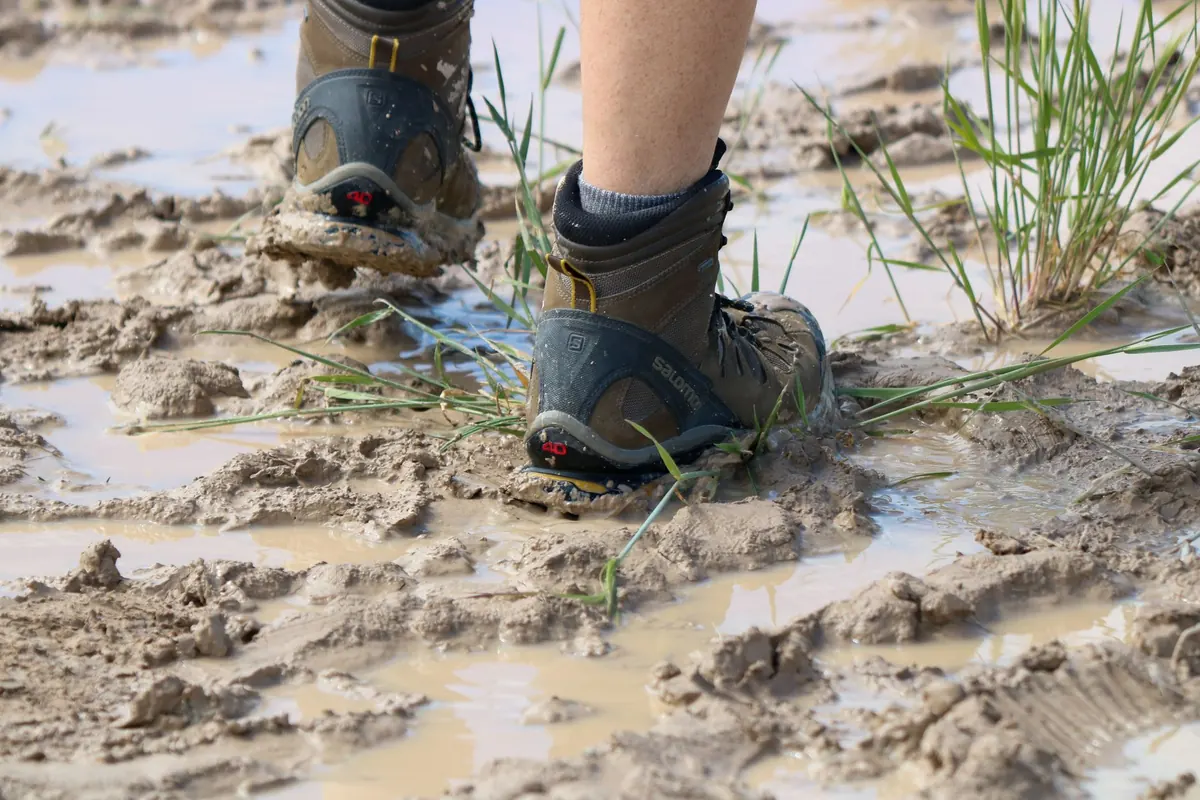
The single most useful rule for wet trails is also the least intuitive: when the path is muddy, walk through the mud.
Going around a puddle feels harmless and is not. Every detour adds a few centimetres to the trail's width, and those centimetres are taken from the plants at the edge. After a wet week you can see the result — a footpath that began as a single line is now two metres wide, with a braided mess of side-channels where the water used to run clean.
Step on rocks, roots and dry hummocks where you can. If the trail is already braided, follow the central, most worn line rather than picking a fresh edge. If a boardwalk or stepping stones exist, use them exactly as intended — stepping off the side to let someone pass pushes the bank down a little further each time.
When the trail is a stream
Sometimes the path itself is carrying water. Walking in the channel is usually the better choice: your boots displace water rather than soil, and you don't create a parallel path on the bank. It is cold and noisy and occasionally ankle-deep, which is a fair description of spring hiking. If you need to stop, step onto rock or dry ground, not into the vegetation beside the flow.
Springs, Banks and the Edge of the Water
A springhead is the most sensitive few square metres on the mountain. It is also the most interesting, so give yourself a moment to look properly rather than trampling it.
Approach from downstream if you want a close view, and stop a few paces short. Kneel or stand on rock or bare gravel instead of the mossy apron around the outflow. Don't move stones to make a pool, don't dam the flow to fill a bottle, and don't stack cairns — rearranging a spring edge changes where the water runs and takes years to undo.
Where a spring feeds a trough or a drinking point for animals, fill your bottle and step back rather than standing over it. Wildlife and livestock will wait, but they will also trample the edge if the approach is left churned.
Water, Waste and Small Rituals
Washing is where good intentions usually leak. Carry water at least sixty metres — around two hundred feet — away from the spring before you wash, rinse a pot or brush your teeth. Use no soap at all near a source, including the biodegradable kind; it still adds nutrients to a system that runs on very little. Strain food scraps from dishwater and pack them out with the rest of your rubbish.
For human waste, dig a small hole fifteen to twenty centimetres deep, well away from water and trails, and carry out the paper in a bag. In fragile alpine ground, or where the rules of a park say otherwise, pack everything out. Check local regulations before you go — the accepted practice varies by area, and the land manager's rules always come first.
Don't rinse a water filter in the spring, and don't swim in a small, still pool that is someone's drinking water a kilometre below. A bottle filled carefully, with the cap kept clean, is the whole ceremony.
When the Trail Is Already a Mess
You will find damaged paths: eroded trenches, mud walls, the widening fan of a shortcut. Resist the urge to build informal repairs. Branch-and-stone barricades often push traffic somewhere worse, and moving rocks off a bank can speed the erosion you were trying to stop.
What helps is reporting. Note the location, take a photograph, and send it to the park or the trail association that maintains the path. Join a maintenance day if there is one nearby. And in the meantime, keep your own line narrow — one careful pair of boots through the middle of the mud is a vote for the trail as it was built.
A Short Checklist Before You Step Off
- Check recent rainfall and snowmelt, not just today's forecast.
- Take gaiters and rubber pole tips for wet sections.
- Walk through the mud, in single file, on the worn line.
- Stay off the springhead and the mossy banks around it.
- Wash and go to the toilet at least sixty metres from any water.
- Pack out paper, scraps and tea bags, and report damage with a photo.
A spring trail asks for less than most: a narrow line, a few wet boots and some patience at the water's edge. Do that, and the path will still be a path — and the spring will still be clear — when you come back next season.
Photo: Deb Hayes / Pexels